

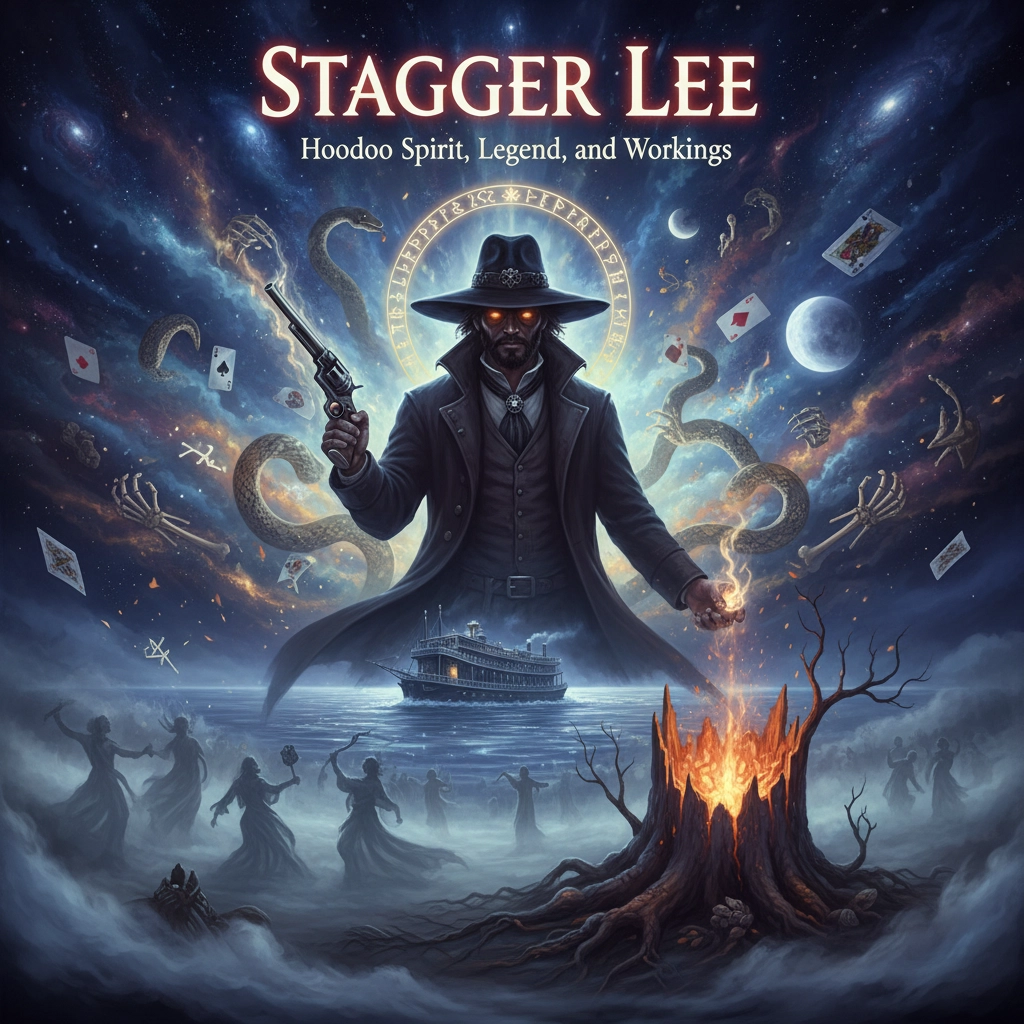
What happens when a single act of violence becomes so powerful that it transcends death itself, conquers hell, and transforms into a spiritual force that entire communities turn to for strength? The legend of Stagger Lee isn't just another folk tale: it's a supernatural phenomenon that has woven itself into the very fabric of African-American spiritual practice and resistance culture.
Most people think they know Stagger Lee. They've heard the songs, maybe caught a blues performance, and assume it's just another badman ballad. But we're not just talking about a folk hero here. We're exploring a figure so formidable that he literally rewrote the rules of the afterlife and became a patron spirit for those who refuse to bow down.
The Blood That Started a Legend
December 25, 1895. Christmas night in St. Louis, Missouri. A gambling dispute over a Stetson hat erupts between "Stag" Lee Shelton and Billy Lyons. Within moments, Lyons lies dying on a saloon floor, and Shelton walks away into the night: and into immortality.
But here's where most tellings get it wrong. This wasn't just another street killing. The moment that bullet found its mark, something shifted in the spiritual realm. The violence was so raw, so defiant of every social order trying to crush Black manhood, that it created a rupture between the physical and spirit worlds.

The witnesses that night described something unsettling about Shelton's demeanor. He didn't flee like a common criminal. He moved with the calm of someone who knew he'd crossed a line that couldn't be uncrossed: and had made peace with the consequences. That's the moment Stagger Lee, the spirit, was born from the ashes of "Stag" Lee Shelton, the man.
Why Jim Crow Couldn't Kill This Spirit
During the darkest days of Jim Crow, when Black bodies were terrorized and Black dignity was systematically dismantled, something extraordinary happened. Communities began whispering about a man who answered to nobody: not white authority, not the law, not even God or the Devil.
They admired Stagger Lee because he embodied what they couldn't express: absolute refusal to submit. While real people faced lynching for looking white folks in the eye, Stagger Lee gunned down anyone who disrespected him and walked away untouched. Law enforcement was too frightened to arrest him. The system that crushed everyone else couldn't touch him.
This wasn't just wish fulfillment: it was spiritual rebellion made manifest. When you're living under a system designed to break your spirit, you need more than hope. You need proof that resistance is possible, even if it comes from beyond the grave.
The Sacred Symbolism of That Stetson Hat
Let's talk about what really sparked this legendary confrontation. It wasn't just any hat: it was a Stetson. And in the early 1900s, for a Black man to own a Stetson was to make a profound statement about his humanity.
These hats cost serious money. Black men would buy them on installment plans, sacrificing other necessities to afford this symbol of dignity. When you were the direct descendant of enslaved people, wearing a Stetson marked you as a free man, equal in status to any well-dressed white man.

The hat represented everything the Jim Crow system tried to strip away: manhood, pride, and the audacious belief that you deserved respect. When Billy Lyons took Stagger Lee's hat, he wasn't just stealing an accessory: he was attacking the very core of his identity. And Stagger Lee's response? Absolute, uncompromising violence in defense of his dignity.
This is why the spirit of Stagger Lee resonates so powerfully in hoodoo and rootwork traditions. He's the patron of those who refuse to let anyone diminish their worth, no matter the cost.
The Badman Who Conquered Hell Itself
Here's where the legend transcends folklore and enters spiritual territory. In the most powerful versions of the story, Stagger Lee is eventually caught, tried, and executed for his crimes. But death? Death was just another authority figure trying to control him.
The ballads describe his arrival in hell with vivid detail. He walks into the underworld like he owns the place, challenges the Devil to a gambling match, wins control of hell itself, and transforms it into his own "badman's paradise." Think about the spiritual audacity of that image: a man so defiant that he overthrows the Prince of Darkness and makes hell into a kingdom for rebels and outcasts.

This supernatural conquest isn't just storytelling flourish. In hoodoo tradition, spirits who demonstrate this level of power become forces you can work with. Stagger Lee represents the ultimate refusal to be controlled, even by cosmic forces. When practitioners call on his energy, they're invoking someone who has literally proven that no authority: earthly or divine: can break a spirit that refuses to submit.
From Folk Ballad to Spiritual Practice
The legend evolved through musical traditions, but each transformation revealed new layers of its spiritual power. Mississippi John Hurt's blues version portrayed Stagger Lee as "cruel" and "bad," emphasizing the consequences of his actions. But Lloyd Price's 1958 recording marked a revolutionary shift: it celebrated Stagger Lee without judgment, without punishment, presenting him as a pure force of defiant energy.
This evolution mirrors how the spirit moved from cautionary tale to patron saint of resistance. Modern practitioners don't work with Stagger Lee because they want to commit violence. They connect with his energy because they need his unshakeable refusal to bow down, his absolute commitment to dignity at any cost.
Working with Stagger Lee's Spirit
Traditional hoodoo practitioners recognize Stagger Lee as a powerful spirit for protection work and justice issues. He's called upon when someone needs the courage to stand up to bullies, resist unjust authority, or defend their dignity against overwhelming odds.
His signature tools include the .44 revolver (represented symbolically in spiritual work), dice for gambling magic, and most powerfully, the Stetson hat as a crown of dignity and self-respect. Practitioners might keep a small hat on their altar or wear one during rituals invoking his protection.

But working with Stagger Lee requires understanding his nature. He's not a gentle guardian spirit. He's the energy of absolute refusal, of lines drawn in sand with blood. When you call on him, you'd better be prepared to stand by your convictions no matter what comes.
The Eternal Rebellion
What makes Stagger Lee endure isn't just the dramatic story or catchy ballads. It's the spiritual truth he represents: that dignity is worth defending with everything you have, that some lines should never be crossed, and that a spirit willing to conquer hell itself will never abandon those who share his refusal to submit.
In a world that still tries to diminish people based on race, class, or any other arbitrary division, Stagger Lee's message resonates as powerfully today as it did in those Jim Crow juke joints. He reminds us that respect isn't negotiable, that dignity isn't a privilege to be granted: it's a birthright to be defended.
The technology serves the tradition, not the other way around. Whether you encounter his story through vinyl records, digital archives, or whispered tales in contemporary spiritual circles, the core truth remains unchanged: Some spirits are too powerful to kill, too defiant to control, and too necessary to ignore.
The legend of Stagger Lee proves that when injustice pushes people to their breaking point, sometimes what breaks isn't the person( it's the very foundations of the world itself.)

