

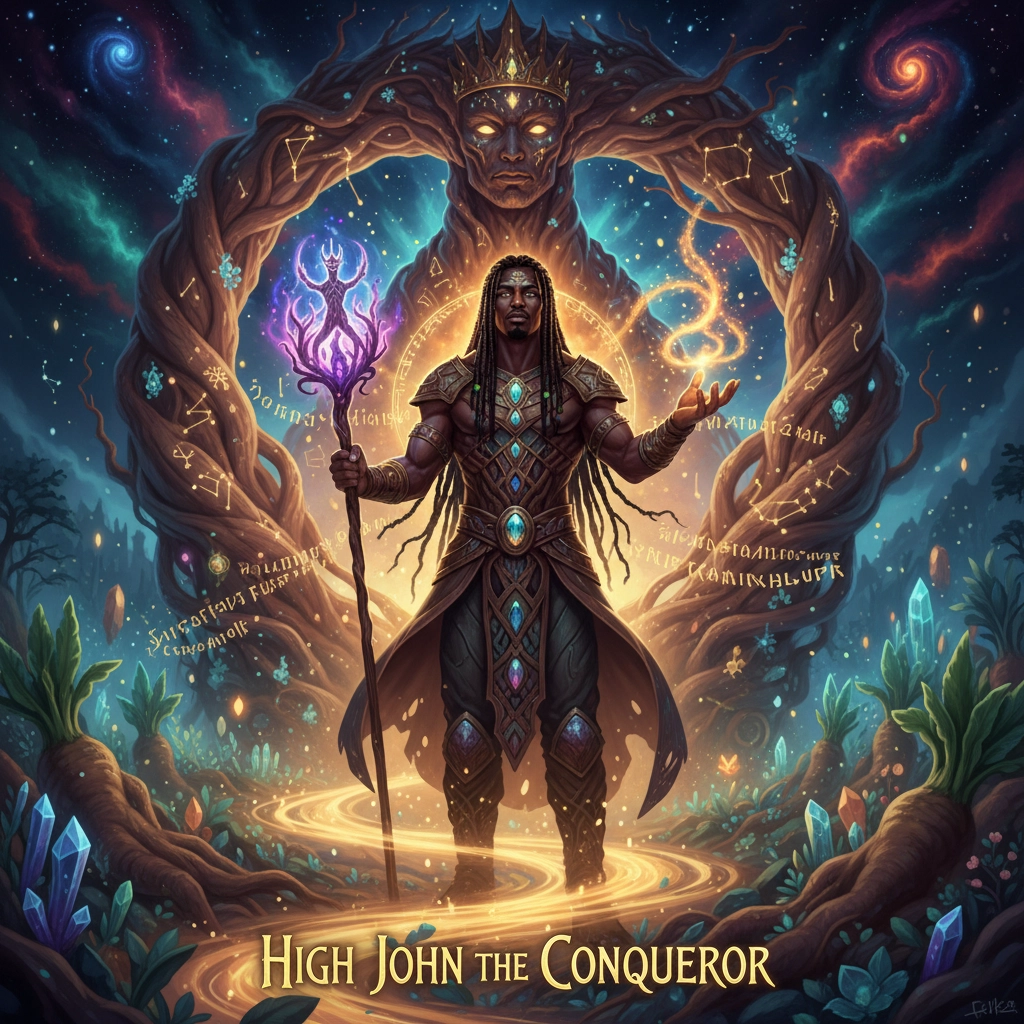
What if I told you that one of the most powerful figures in American spiritual traditions was never truly enslaved? That despite chains, whips, and the most brutal oppression imaginable, there lived a man whose spirit could never be broken: a prince whose laughter echoed through the cotton fields and whose magic turned the impossible into reality?
Meet High John the Conqueror, the ultimate trickster, the unbreakable spirit, and the folk hero whose legacy continues to empower people centuries after his legendary return to Africa. This isn't just another historical figure gathering dust in forgotten stories. This is about a revolutionary force that transformed despair into hope, oppression into opportunity, and suffering into strength.
The Prince Who Refused to Bow
High John wasn't just any enslaved person: he was royalty with an attitude. According to the rich oral traditions passed down through generations, he was a prince from the Congo, captured and brought to America in chains. But here's where the story gets interesting: while his body may have been in bondage, his spirit remained gloriously, defiantly free.
Picture this: a man who could walk on water, travel through dreams, and outwit the devil himself. High John possessed something that no enslaver could touch: an unshakeable belief in his own power and an infectious optimism that spread like wildfire through the slave quarters. He didn't just survive the horrors of slavery; he thrived, turning every impossible situation into an opportunity for triumph.

The beauty of High John's character lies in his multifaceted nature. He was the cosmic trickster connected to West African traditions, particularly echoing the energy of Esu from Yoruba cosmology. Yet he was also deeply rooted in the American experience, speaking directly to the unique struggles and victories of enslaved Africans in the New World. He bridges worlds, cultures, and dimensions of power that most of us can barely imagine.
When the Devil Met His Match
The most famous tale of High John's adventures reads like the ultimate underdog story: except our hero was never really the underdog. The story goes that High John fell head over heels for Lilith, the devil's own daughter. When word reached the devil about this romance, you can imagine his reaction wasn't exactly celebratory.
The devil, thinking he was clever, set what he believed were impossible tasks. "You want my daughter?" he sneered. "Then plow sixty acres in half a day, plant corn, and harvest it all before sunset." Most would have walked away. High John? He smiled and got to work.
But this wasn't about brute force or even ordinary magic. High John understood something profound: true power comes from partnership, wisdom, and knowing when to accept help. Lilith, equally enchanted by this remarkable man, provided him with magical tools: an axe that could clear land in minutes and a plow that could do the work of a hundred men.

The tasks were completed with time to spare, but Lilith had a warning: "My father plans to kill you regardless." Lesser men might have despaired, but High John? He saw opportunity. Together, they stole the devil's own horse and rode off into legend, proving that love and cleverness could conquer even the forces of hell.
The Root of All Power
Here's where legend meets reality in the most beautiful way possible. Before High John returned to Africa with his beloved Lilith, he made a promise to his people: his power would remain with them forever. But how do you leave spiritual power behind? You embed it in something living, something that can be touched, carried, and worked with.
Enter the High John the Conqueror root: Ipomoea jalapa or Ipomoea purga: a humble plant that became the physical manifestation of an extraordinary spirit. This wasn't just any plant; it was introduced to enslaved Africans by Native Americans, creating a beautiful confluence of indigenous wisdom and African spiritual technology.
The root carries everything High John represented: unshakeable confidence, the ability to turn situations around, protection from harm, and that infectious laughter that could lift spirits even in the darkest times. When you hold a High John root, you're not just holding a piece of plant matter: you're connecting with centuries of resistance, resilience, and the unbreakable human spirit.

In hoodoo practices, the High John root is more than a lucky charm: it's a spiritual powerhouse. Practitioners carry it for success in legal matters, confidence in challenging situations, and the ability to overcome seemingly impossible odds. The root embodies the principle that no situation is hopeless, no opponent too powerful, and no dream too big.
The Revolutionary Spirit Lives On
What makes High John the Conqueror so relevant today? In a world where people still face impossible odds, systemic oppression, and seemingly insurmountable challenges, his message rings clearer than ever: your spirit cannot be broken unless you allow it to be.
Zora Neale Hurston captured this beautifully when she wrote about High John as one who "walked the winds like the albatross." She understood that this wasn't just folklore: this was revolutionary psychology. High John represented the power of the human spirit to transcend circumstances, to find joy in the midst of suffering, and to maintain dignity when the world tries to strip it away.
The blues musicians knew this too. When Muddy Waters sang about Johnny Cocheroo in "I'm Your Hoochie Coochie Man," he wasn't just name-dropping: he was invoking that same indomitable spirit, that same refusal to be defeated by circumstance. High John's influence flows through American culture like an underground river, surfacing wherever people need reminding of their own power.

Today, High John's story resonates with anyone who has ever felt powerless, overlooked, or underestimated. His legacy isn't confined to any single spiritual practice or cultural tradition: it belongs to everyone who needs reminding that the most powerful forces in the universe aren't always the most obvious ones.
Your Own High John Moment
The real question isn't whether High John the Conqueror actually existed as a historical person. The question is: what impossible situation are you facing right now that needs his kind of spiritual intervention? What chains: mental, emotional, or spiritual: are you ready to break free from?
High John's power wasn't in performing miracles: it was in changing perspectives. He showed people that every problem contains the seeds of its own solution, that every oppressor has a weakness, and that laughter really can be the most revolutionary act of all.
Whether you work with the actual High John root in traditional hoodoo practices or simply carry his story as inspiration, the message remains the same: you are more powerful than you know, more resilient than you imagine, and more capable of transformation than you dare to believe.
The prince from the Congo who refused to be conquered lives on: not just in roots and folklore, but in every moment when someone chooses hope over despair, creativity over resignation, and laughter over tears. That's the real magic of High John the Conqueror: he reminds us that the most unbreakable thing in the universe is the human spirit that refuses to give up.
Your High John moment is waiting. The only question is: are you ready to claim it?

