

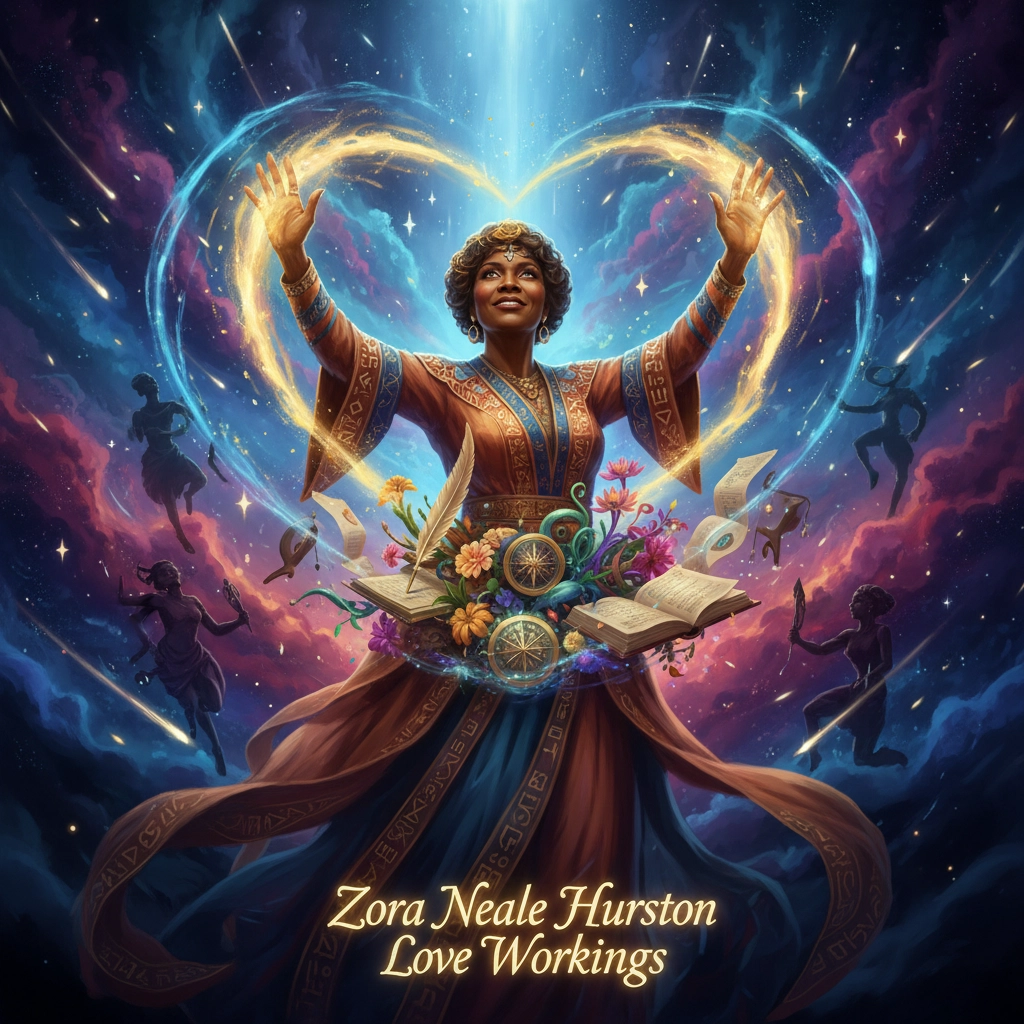
What if the most powerful love magic ever documented in America wasn't written by a mystical guru or ancient sage, but by a brilliant Black woman who walked boldly into the spiritual underground of the 1930s South? Meet Zora Neale Hurston – not just the celebrated author of "Their Eyes Were Watching God," but the fearless anthropologist who risked everything to preserve the sacred love workings of African American hoodoo tradition.
While most of her contemporaries dismissed these practices as mere superstition, Hurston recognized something revolutionary: she was witnessing the living heart of African spiritual wisdom, transformed and sustained through generations of struggle, creativity, and profound faith.
The Woman Who Walked Between Worlds
Zora Neale Hurston didn't just study hoodoo – she lived it. In the 1920s and 1930s, when academic anthropology was dominated by white male scholars who observed cultures from the outside, Hurston did something radical. She went home. She returned to the South, to her people, and immersed herself completely in the spiritual practices that had been hiding in plain sight.
But this wasn't academic tourism. Hurston understood that to truly document these sacred love workings, she had to be more than an observer – she had to become an initiate. She sought out root doctors, conjure women, and spiritual practitioners who had kept these traditions alive despite centuries of oppression and ridicule.

The result was something unprecedented in American anthropology: an authentic, insider's view of African American folk magic that honored both its spiritual power and cultural significance. Where others saw "primitive beliefs," Hurston saw sophisticated spiritual technology that had sustained her community through the darkest chapters of American history.
Love Magic as Sacred Technology
What makes Hurston's documentation of love workings so extraordinary isn't just their authenticity – it's her recognition that these weren't random spells, but carefully constructed spiritual technologies passed down through generations. Each working she recorded in "Mules and Men" represents centuries of refinement, testing, and transmission within African American communities.
Take her documentation of "To Make a Man Come Home" – a ritual so precise it reads like a spiritual recipe that has been perfected over generations. Nine deep red or pink candles, each inscribed with the person's name three times. The candles washed with Van-Van oil, names written on paper placed beneath. Lighting at specific hours – seven, nine, or eleven – while calling the person's name three times. This isn't folklore; this is applied metaphysics.
The working "To Make People Love You" reveals even deeper spiritual sophistication: nine lumps each of starch and sugar combined with nine teaspoons of steel dust, moistened with Jockey Club cologne. The mixture divided into nine portions, each wrapped in colored ribbon while repeatedly calling the target's name. These nine bags then hidden throughout the home in strategic locations.
But here's what makes Hurston's documentation revolutionary – she included the spiritual philosophy behind the workings. As one practitioner told her: "Distance makes no difference. Your mind is talking to his mind and nothing beats that." This wasn't just about ingredients and procedures; it was about understanding the metaphysical principles of consciousness, intention, and spiritual connection.

The Courage to Preserve What Others Dismissed
Picture this: a brilliant Black woman in the 1930s South, walking into rooms where white academics fear to tread, earning the trust of spiritual practitioners who have every reason to be suspicious of outsiders. Hurston didn't just collect these love workings – she earned the right to receive them.
This required more than academic credentials. It demanded cultural authenticity, spiritual sensitivity, and the kind of courage that only comes from understanding what's at stake. Hurston knew she wasn't just documenting quaint folk practices – she was preserving a sophisticated spiritual system that connected her community to their African roots and provided real power in the face of systemic oppression.
The love workings she documented weren't just about romantic attraction – they were about agency, about claiming power in a world that denied Black people both. When someone performed a love working, they were asserting their spiritual authority, their right to shape their destiny, their connection to forces greater than the social systems designed to diminish them.
Beyond Romance: Love as Spiritual Resistance
What emerges from Hurston's documentation is something far more complex than simple love spells. These workings represent a complete spiritual worldview where love magic served as a form of resistance, empowerment, and community healing. The practitioners Hurston worked with understood something profound: in a world that sought to control, diminish, and dehumanize Black people, the ability to work spiritual influence was an act of revolutionary self-determination.
Consider the sophistication of the timing elements in these workings – specific hours, particular moon phases, carefully counted repetitions. This reflects deep knowledge of natural cycles, energy patterns, and the metaphysical principles governing attraction and influence. These weren't desperate acts of superstition; they were expressions of a spiritual science that understood the hidden connections between all things.

Hurston also documented workings for breaking up relationships, revealing the full spectrum of love magic as a tool for both creating and destroying romantic bonds. These involved broken needles, candles of specific colors, and materials gathered from the street, all combined in elaborate multi-day rituals. The complexity suggests generations of experimentation and refinement, spiritual technologies tested and proven over time.
The Living Legacy of Sacred Documentation
Today, nearly a century after Hurston walked those dusty Southern roads collecting these precious workings, her documentation stands as something extraordinary: a bridge between worlds, a testament to the resilience of African spiritual wisdom, and proof that love magic is far more than romantic manipulation – it's about claiming spiritual agency in a complex universe.
Her work challenges us to look deeper than surface appearances. Where mainstream culture might see superstition, Hurston revealed sophisticated spiritual practice. Where others might see relics of the past, she documented living traditions that continue to evolve and serve their communities. Where academic anthropology often extracted and objectified, Hurston honored and preserved.
The love workings in "Mules and Men" aren't museum pieces – they're invitations to understand that the spiritual technologies developed by oppressed communities often contain wisdom that privileged traditions have forgotten. They remind us that authentic spiritual practice grows from the soil of lived experience, cultural connection, and the urgent need to find power in powerless circumstances.
Transforming How We See Spiritual Wisdom
What makes Hurston's love workings documentation revolutionary isn't just what she preserved – it's how she transformed our understanding of where spiritual wisdom comes from and who has the right to be taken seriously as spiritual authorities. By treating root doctors and conjure women as legitimate spiritual practitioners rather than colorful folk characters, she challenged the racist assumptions that dismissed African-derived traditions as inferior to European spiritual systems.
Her work suggests something powerful: that some of the most sophisticated spiritual technologies in America weren't developed in universities or imported from ancient texts, but forged in the crucible of survival, sustained by communities who understood that spiritual practice isn't luxury – it's necessity.

The precision, complexity, and effectiveness of the love workings Hurston documented prove that dismissing folk traditions as "primitive" says more about the observer's limitations than the traditions themselves. These workings represent generations of spiritual innovation, testing, and refinement by practitioners who understood that their lives often depended on their ability to work spiritual influence.
The Continuing Revolution
Every time someone reads Hurston's documentation with respect rather than condescension, every time these love workings are understood as legitimate spiritual practice rather than quaint folklore, every time her work inspires deeper appreciation for African American spiritual wisdom – the revolution continues.
Hurston didn't just preserve love workings; she preserved dignity, authenticity, and the right of marginalized communities to be recognized as sources of spiritual wisdom rather than objects of academic curiosity. Her work reminds us that the most powerful magic often comes not from ancient books or exotic traditions, but from the communities who have maintained their spiritual connections despite every effort to sever them.
The love workings she documented continue to speak across decades, offering not just techniques for romantic influence, but windows into a worldview where spiritual practice, cultural identity, and personal empowerment are inseparably intertwined. In preserving these sacred technologies, Hurston gave us more than historical documentation – she gave us an invitation to recognize the spiritual wisdom that surrounds us, waiting to be honored rather than dismissed, preserved rather than forgotten, practiced rather than merely studied.

